

DIY Donation Forms: Why the Math Rarely Adds Up
Some nonprofits consider building their own online donation tool to save on fees. But does that math really add up?
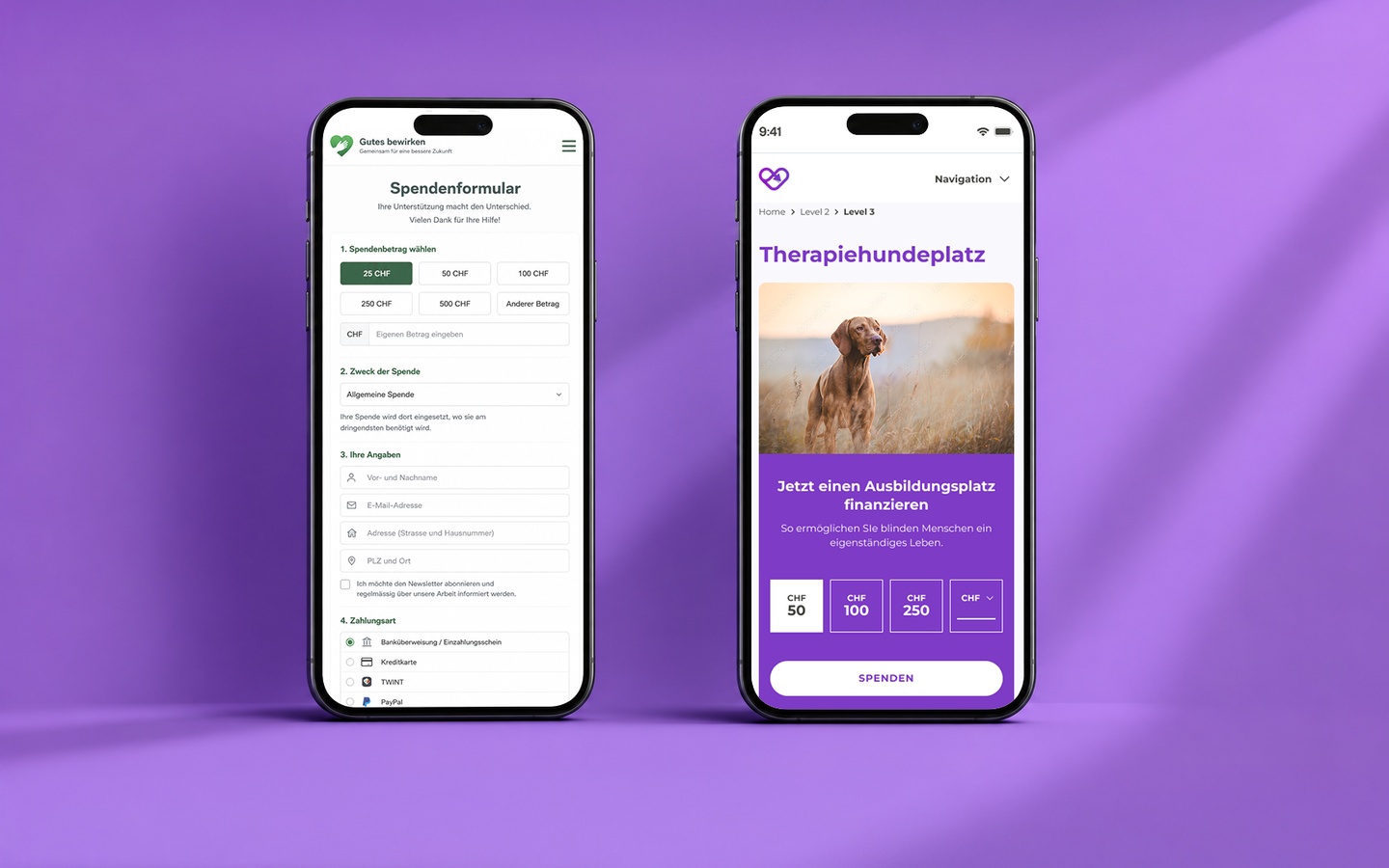
As online donation volumes grow, the fees charged by many donation tools quickly become a sticking point. As a result, many organizations ask themselves: should we build our own donation tool?
The idea seems attractive at first glance — lower payment fees, more control, and no reliance on outside vendors. In practice, however, the math often doesn't add up as neatly.
In this article, we use a concrete example — a nonprofit with around CHF 250,000 in annual online donations — to show what costs and challenges actually arise with in-house development, and what matters most when making the make-versus-buy decision.
Nonprofit Aren't Software Companies
Today's fundraising landscape is only getting more competitive. Donor expectations are rising, competition among organizations is intensifying, and fundraising teams are under constant pressure to do more with fewer resources. In that environment, investing time and budget into developing and operating custom software rarely pays off.
The same applies to most web agencies that build these solutions. While they're excellent at delivering projects, they typically aren't set up to operate and continuously optimize a fundraising tool over the long term.
If you build your own solution, your organization becomes fully responsible for everything that follows: hosting, maintenance, security, compliance, integrations, performance improvements, and future development.d
Total Cost of Onwership runs higher than Off-the-Shelf Tools
"It's just some hosting and a few updates — that's not going to add up to much."
We hear statements like this time and again when organizations consider building their own donation form. The focus is usually on initial development costs, while ongoing operations get heavily underestimated.
Research from IBM and Gartner tells a different story: initial development typically accounts for only about 20% of total cost of ownership. Any make-or-buy analysis needs to compare the full lifecycle costs realistically. See also: Software maintenance - Wikipedia
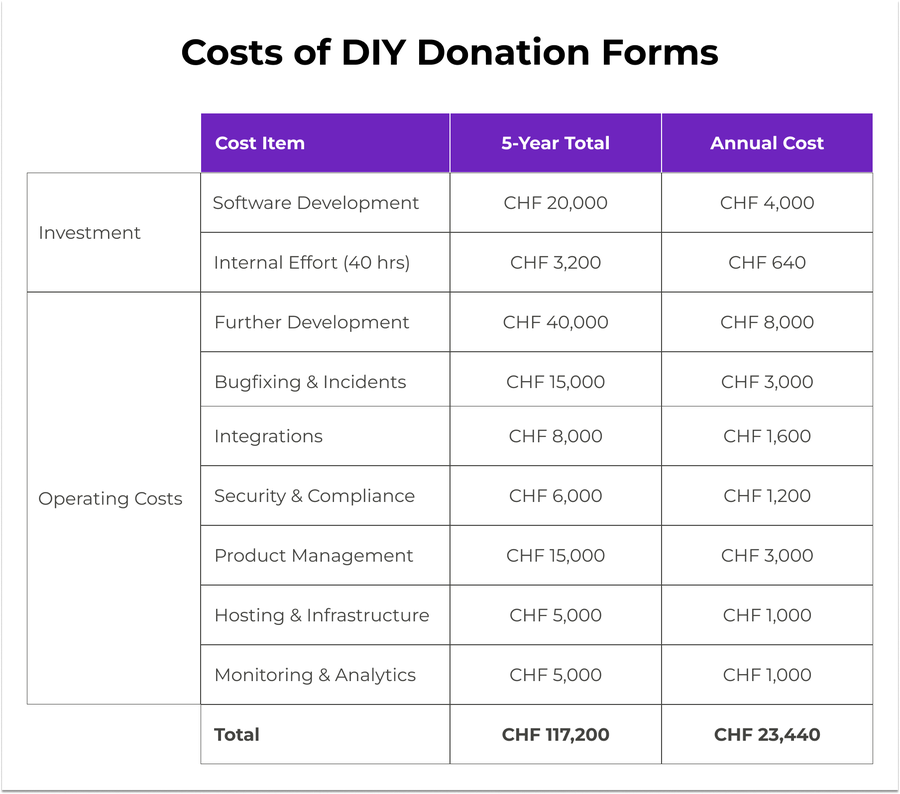
For a basic setup with an initial investment of around CHF 20,000, total costs over five years quickly climb to CHF 100,000–120,000 — roughly CHF 15,000–20,000 per year.
The main argument for building your own tool is usually lower payment fees. But that assumption doesn't hold up: specialized platforms like Soulclick, with fees in the 1.0–1.2% range, often come with lower costs than a self-built solution running on Stripe or other payment processors.
Conversions Don't Happen by Accident
The donation form is one of the key steps in the donor journey. Once a donor is ready to give, the process needs to be quick and easy.
A seamlessly working donation tool is often the result of years of optimization — from user experience to mobile design, handling failed or abandoned payments, and choosing the right suggested donation amounts. Many of these details may seem minor, but they have a direct impact on conversion rates.
A self-built form starts without any of that experience. Even modeling it on existing solutions won't capture the fine-tuning that comes from years of real-world testing. Even small differences in loading times or user experience can lead to fewer completed donations.
Here's what that looks like in practice: for a nonprofit raising CHF 250,000 online per year, a conversion rate just 15% lower — with the same average gift size translates to about CHF 25,000 in lost revenue.
The real question, then, isn't just what a donation tool costs but how much revenue it actually generates.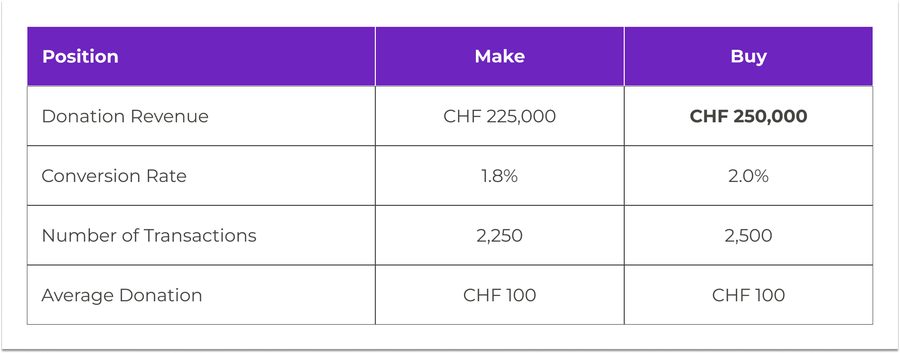
Conclusion: DIY Donation Forms Are Rarely a Good Option
Building your own donation form may seem attractive at first, but over the medium term it brings significantly higher costs and more complexity than a SaaS donation tool. Initial development is rarely the main cost and complexity driver. The real challenges and costs show up in ongoing operations: further development, compliance, integrations, and internal processes. Keeping up with technological developments and specialized donation tools is hardly realistic for a single nonprofit.
Building in-house also pulls resources away from where nonprofits have the greatest leverage: campaigning, storytelling, and donor engagement. On top of that come added risks around security and data protection, along with limitations in data quality and analytics.
Especially in fundraising, where trust and speed are crucial, building your own solution is usually the more expensive and less efficient option.